

When you think of wolves, what comes to mind? Is it the fierce howl echoing through the night or the tight-knit pack loyalty? Across cultures, wolves symbolize strength, cunning, and independence—traits many admire and wish to embody. That’s why names meaning “wolf” carry a special punch, weaving deep meaning with a dash of wild spirit.

Popular Names That Mean Wolf Across Cultures
| Name | Meaning | Origin |
|---|---|---|
| Wolfgang | Traveling wolf | German |
| Lowell | Young wolf | French |
| Accalia | She-wolf | Latin |
| Zev | Wolf | Hebrew |
| Lupo | Wolf | Italian |
| Randolf | Shield wolf | Old Norse/German |
| Conri | Wolf king | Irish |
| Ulric | Wolf power | Germanic |
| Raoul | Wise wolf | French/Old German |
| Lyall | Wolf | Scottish |
| Rolo | Famous wolf | Frankish |
| Bardou | Bright wolf | French/Germanic |
| Gunnolf | Battle wolf | Old Norse |
| Wulfram | Wolf raven | Germanic |
| Adalwolf | Noble wolf | German |
| Bledig | Wolf | Welsh |
| Faolan | Little wolf | Irish |
| Lupu | Wolf | Romanian |
| Varg | Wolf | Scandinavian |
| Eadwulf | Prosperous wolf | Old English |
| Gorgo | Fierce wolf | Greek |
| Channing | Young wolf | Old French |
| Dolph | Noble wolf | Short for Rudolf |
| Otsoko | Little wolf | Basque |
| Beowulf | Bee wolf (bear) | Old English |
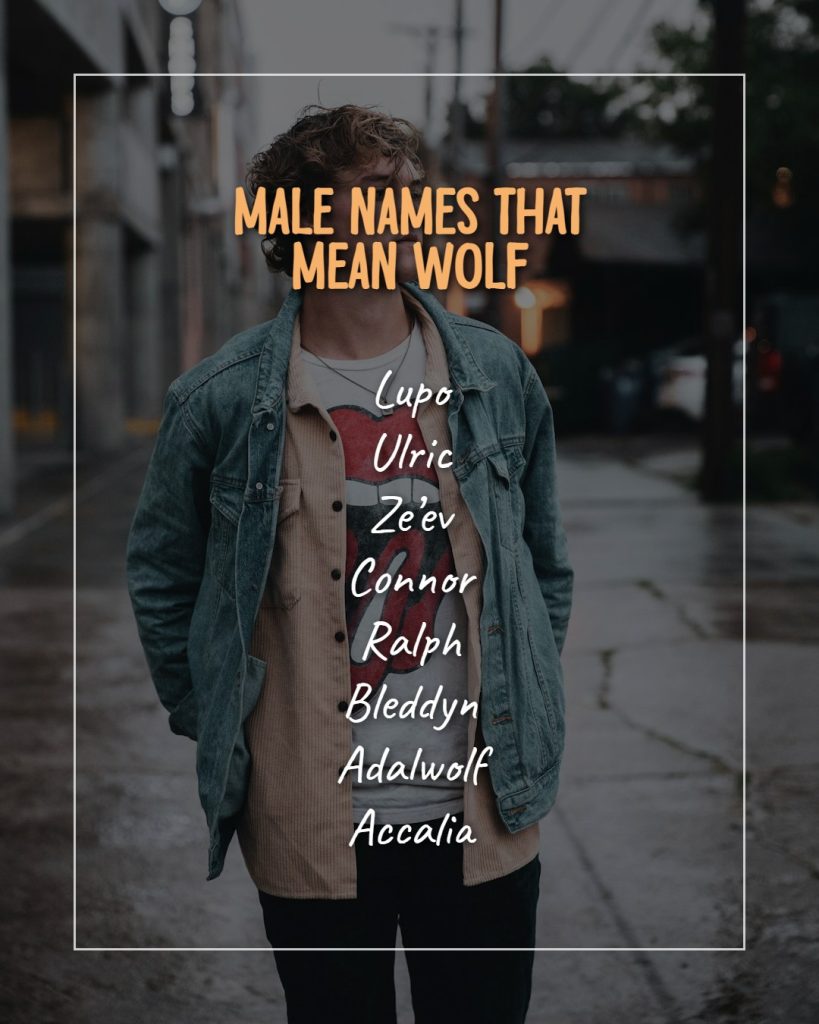
Male Names That Mean Wolf
| Name | Meaning | Origin |
|---|---|---|
| Connor | Wolf lover | Irish |
| Ulric | Wolf power | Germanic |
| Wulfstan | Wolf stone | Anglo-Saxon |
| Rudi | Famous wolf | German |
| Bardulf | Ax wolf | Germanic |
| Rolf | Renowned wolf | German/Scandinavian |
| Odolf | Wealthy wolf | Germanic |
| Gunnolf | Battle wolf | Old Norse |
| Tiwolf | Sacred wolf | Proto-Germanic |
| Arnou | Eagle wolf | French |
| Adalwulf | Noble wolf | German |
| Ethelwulf | Noble wolf | Anglo-Saxon |
| Lupin | Of the wolf | Latin |
| Raulf | Wise wolf | Germanic |
| Ulf | Wolf | Scandinavian |
| Zev | Wolf | Hebrew |
| Acco | Wolf (nickname) | Latin |
| Skoll | Treacherous wolf | Norse Mythology |
| Fenrir | Giant wolf | Norse Mythology |
| Lykos | Wolf | Greek |
| Wulfric | Wolf ruler | Anglo-Saxon |
| Velvel | Little wolf | Yiddish |
| Vilkas | Wolf | Lithuanian |
| Dolph | Noble wolf | Short for Rudolf |
| Wolfram | Wolf raven | Germanic |

Check This Out: 100+ Names That Mean New Beginning – Beautiful Fresh Start Names
Female Names That Mean Wolf
| Name | Meaning | Origin |
|---|---|---|
| Accalia | She-wolf | Latin |
| Blevine | Wolf | Welsh |
| Rudelle | Famous wolf | French |
| Ulva | Female wolf | Germanic |
| Faolánna | Little she-wolf | Irish (feminized) |
| Lupita | Little wolf | Spanish |
| Lupa | She-wolf | Latin |
| Adolpha | Noble she-wolf | German |
| Randolpha | Shield she-wolf | Germanic |
| Velvela | Little she-wolf | Yiddish |
| Loveta | Beloved wolf | French/Modern |
| Louve | She-wolf | French |
| Tala | Wolf (in some tribes) | Native American |
| Vargka | She-wolf (fictionalized) | Slavic-inspired |
| Channelle | Young wolf | French |
| Faoileann | Little wolf | Irish |
| Maikoh | Wolf | Navajo |
| Ula | Wolf | Old German |
| Lycia | Wolfish | Greek/Modern mix |
| Tamaska | Mighty wolf | Native American (modern usage) |
| Senka | Shadow of a wolf | Slavic |
| Otsana | She-wolf | Basque |
| Lulua | Playful she-wolf | Invented (inspired) |
| Adoette | Big tree/wolf connection | Native American |
| Vukka | Wolf girl | Fictional/Slavic feel |

Gender-Neutral Names That Mean Wolf
| Name | Meaning | Origin |
|---|---|---|
| Zev | Wolf | Hebrew |
| Faelan | Little wolf | Irish |
| Lupin | Of the wolf | Latin |
| Wulf | Wolf | Germanic |
| Lioran | Like a wolf | Fictional/Blended |
| Tamaska | Mighty wolf | Native American (modern usage) |
| Lupa | She-wolf | Latin (now unisex in usage) |
| Varg | Wolf | Scandinavian |
| Lyall | Wolf | Scottish |
| Otsoko | Little wolf | Basque |
| Wolfie | Diminutive wolf | English diminutive |
| Rudi | Famous wolf | Short/Germanic |
| Sköll | Treachery wolf | Norse mythology |
| Fen | Wolf-like spirit | Short for Fenrir |
| Rolo | Famous wolf | Germanic |
| Kaiwolf | Sea + wolf | Modern blended name |
| Ulva | Female wolf | Now used unisex |
| Tual | Small wolf | Breton |
| Velvel | Little wolf | Yiddish |
| Vukka | Wolf child | Invented/Slavic tone |
| Aran | Wild strength (wolfy tone) | Hebrew |
| Kiba | Fang/Wolf | Japanese (anime usage) |
| Amarok | Giant wolf spirit | Inuit Mythology |
| Nighteyes | Wolf bond name | Literature (Robin Hobb) |
| Ardwolf | Earth wolf | Dutch/German |

Don’t Miss This: Names That Mean Traveler: A Guide to Meaningful Nomadic Names
Ancient and Mythological Wolf Names
| Name | Meaning | Origin |
|---|---|---|
| Fenrir | Giant wolf | Norse Mythology |
| Sköll | Treachery wolf | Norse Mythology |
| Hati | He who hates | Norse Mythology |
| Amarok | Giant wolf spirit | Inuit Mythology |
| Lupa | She-wolf | Roman Mythology |
| Lycaon | Turned into a wolf | Greek Mythology |
| Romulus | Raised by a she-wolf | Roman Mythology |
| Remus | Twin of Romulus | Roman Mythology |
| Anubis | Jackal-headed god (wolf-like) | Egyptian Mythology |
| Geri | Ravenous (one of Odin’s wolves) | Norse Mythology |
| Freki | Greedy (Odin’s wolf) | Norse Mythology |
| Wepwawet | Opener of ways (wolf god) | Egyptian Mythology |
| Akkalutho | Wolf (protective spirit) | Ancient Semitic |
| Ashina | She-wolf ancestress | Turkic Mythology |
| Kapu | Forbidden/spirit wolf | Hawaiian Mythology |
| Mahigan | Wolf | Algonquian |
| Okami | Wolf deity | Japanese Mythology |
| Vučko | Little wolf | Slavic Mythology |
| Turul | Mythical bird-wolf hybrid | Hungarian Folklore |
| Lykos | Wolf | Ancient Greek |
| Lykaios | Of the wolf | Greek Mythology |
| Intulo | Messenger (wolf-like) | Zulu Mythology |
| Tsul ‘Kalu | Giant/wolfish being | Cherokee Mythology |
| Adlet | Half-human, half-wolf | Inuit Mythology |
| Macha | Warrior queen with wolf aspect | Celtic Mythology |

Wolf-Related Names in Literature and Folklore
| Name | Meaning/Role | Origin/Literature Source |
|---|---|---|
| Grey Wind | Direwolf of Robb Stark | Game of Thrones |
| Ghost | White direwolf of Jon Snow | Game of Thrones |
| Nighteyes | Bonded wolf companion | Farseer Trilogy by Robin Hobb |
| Maugrim | Wolf captain of the White Witch | The Chronicles of Narnia |
| Raksha | Mother wolf of Mowgli | The Jungle Book |
| Akela | Leader wolf | The Jungle Book |
| White Fang | Wild wolf-dog hybrid | White Fang by Jack London |
| Buck | Dog-turned-wild | Call of the Wild |
| Fenris Ulf | Evil wolf (Narnia version) | The Lion, the Witch and the Wardrobe |
| Remus | Raised by wolf | Roman Mythology/Folklore |
| Romulus | Twin raised by wolf | Roman Mythology/Folklore |
| Gmork | Werewolf-like creature | The NeverEnding Story |
| Amarok | Spirit wolf | Inuit Lore (frequent in fiction) |
| Wolfie | Friendly/quirky wolf name | Modern Literature/Nicknames |
| Lupin | Werewolf teacher | Harry Potter |
| Sirius | Dog star (wolf-like animagus) | Harry Potter |
| Bigby Wolf | Detective wolf | Fables comic series |
| Princess Mononoke | Raised by wolves | Princess Mononoke (Studio Ghibli) |
| Moro | Wolf goddess | Princess Mononoke |
| Shiro | White wolf | Anime/Folklore |
| Wolf | Lone hero | Into the Forest and others |
| Dances With Wolves | Human named by wolves | Film/Literary Fiction |
| Torolf | Thor’s wolf | Norse/Fictional blend |
| Varg | Name with wolf themes | Norse/Modern Literature |
| Lobo | Wolf (outlaw wolf) | Lobo the King of Currumpaw |
The Symbolism of Wolves in Different Cultures
Wolves have long held a complex role in myths and legends worldwide. In Native American traditions, wolves often represent guardianship, intelligence, and freedom. Meanwhile, in Norse mythology, the wolf Fenrir is a symbol of immense power and chaos, yet also a force that shapes destiny. The Romans saw the wolf as a nurturing figure, thanks to the tale of Romulus and Remus being raised by a she-wolf. Even in East Asia, wolves can be both protectors and harbingers of change. This rich tapestry of symbolism makes wolf-inspired names deeply meaningful, carrying echoes of bravery and resilience.
The Power and Meaning Behind Wolf Names
Names meaning “wolf” come from all corners of the globe and often highlight different facets of the animal’s nature. Take “Ulric,” an old Germanic name that translates to “wolf ruler,” blending leadership with wildness. Or “Ze’ev,” a Hebrew name simply meaning “wolf,” popular in Israel and rich in biblical resonance. In Slavic languages, “Volk” and its variants signify not just the animal but also strength and courage. Even “Conri,” an Irish name, means “wolf king,” invoking the idea of nobility tied to the wild.
Conclusion
So, why do these names endure? Maybe it’s because the wolf represents something we all secretly crave—a mix of independence, power, and connection. Choosing a name that means wolf isn’t just about calling on nature’s fierce side; it’s about embracing a legacy of strength and spirit that spans continents and centuries. Now, isn’t that a howl-worthy heritage to carry?

Hi, I’m Gudda Singh Rauthan, but most people call me Gudda. Originally from Jaspur, Uttarakhand, my journey has been full of struggles and learning. I’ve worked in various fields, from factory labor to the BPO industry, and along the way, I discovered my love for writing. Through this blog, I share my experiences and insights to help others build a winning mindset and stay motivated, no matter the challenges they face.