
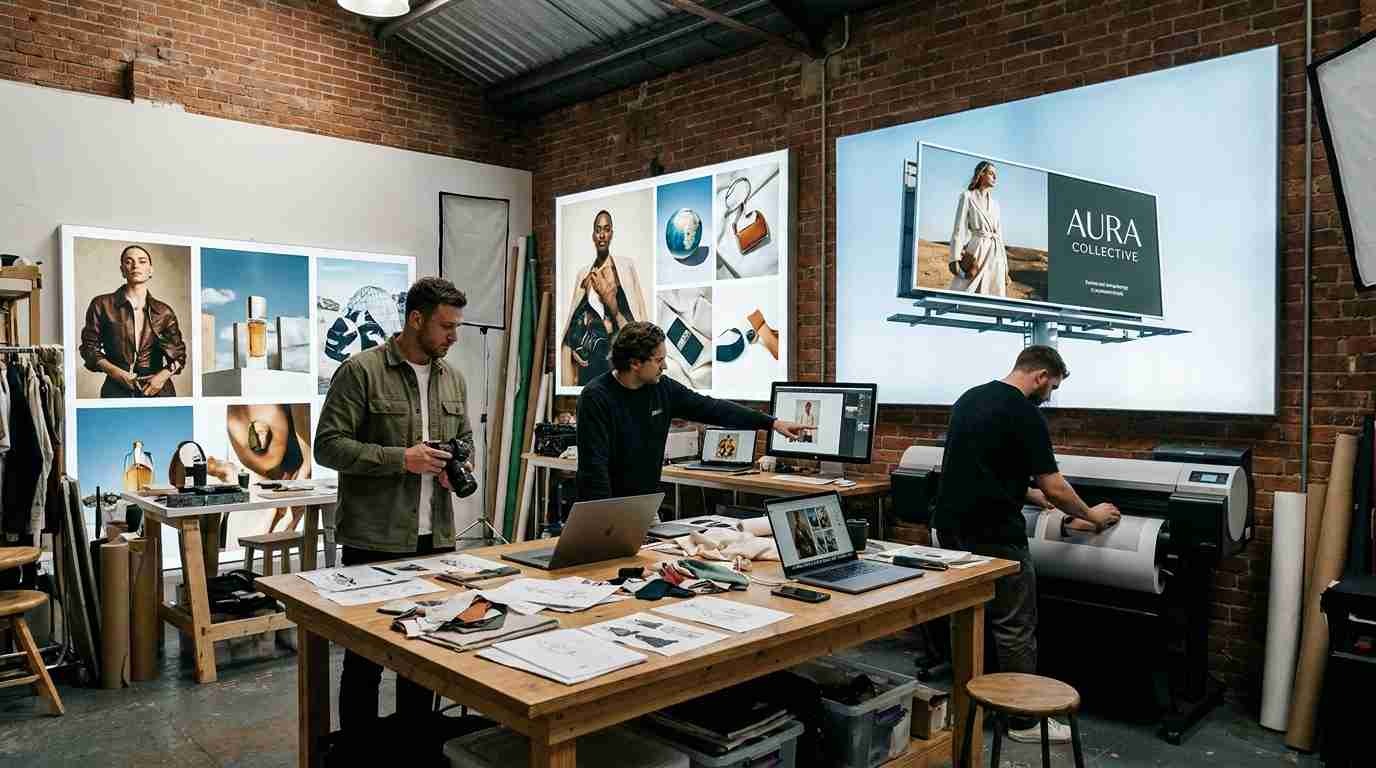
When it comes to competing for attention in a crowded market, lean marketing teams have always had to be smarter with fewer resources than the enterprise teams sitting across the table from them. The budget gap is real. The headcount gap is real. And for a long time, the visual content gap was just as real bigger brands could produce more imagery, more frequently, across more channels, and smaller teams simply could not keep pace no matter how talented the individuals on them were.
That dynamic is shifting. And the shift is happening faster than most people in marketing leadership have fully registered.
An ai image generator has changed the production economics of visual content in a way that disproportionately benefits lean teams. Not because it makes everything easy it does not but because it removes the specific bottleneck that hurt smaller operations the most: the gap between creative ambition and production capacity.
I have watched this play out across teams of different sizes over the past year, and the pattern is consistent. The lean teams that have integrated ai image generation into their workflows are producing visual content at a volume and variety that their headcount would never have supported before. That is a competitive shift worth paying close attention to.
Why Lean Teams Were Always at a Visual Disadvantage
From my experience working with and inside small marketing teams, the visual content problem was never about creativity. Lean teams are often extraordinarily creative constraint tends to produce that. The problem was always production throughput.
A two or three person marketing team supporting a growing company cannot staff a designer dedicated to content production. That designer, if they exist at all, is split across brand, product, sales support, and whatever the leadership team needs this week. The idea that they also have bandwidth to produce campaign imagery at the volume a modern multi-channel marketing program actually requires is, in most cases, a fiction everyone politely maintains.
The workaround has traditionally been stock photography. It is fast, it is relatively cheap, and it is entirely generic. Every competitor in your category has access to the same libraries, which means using stock imagery at scale is essentially a commitment to visual undifferentiation. Your brand looks like every other brand, because you are all pulling from the same pool.
An ai image generator changes that calculation entirely. According to HubSpot’s State of Marketing report, visual content is among the highest-performing content types across channels and teams that produce original, on-brand imagery consistently outperform those relying on generic stock. Lean teams using tools like Higgsfield are now able to produce that original imagery without a photography budget or a dedicated design resource.
The Specific Ways AI Image Generation Levels the Playing Field
The competitive advantage an ai image generator creates for lean teams is not abstract. It shows up in specific, measurable ways across the channels that matter most.
Social media consistency. Large brand teams maintain visual consistency across social channels because they have the resources to produce enough content to keep up with posting schedules. Lean teams typically cannot, which means their social presence looks inconsistent bursts of strong content followed by gaps or low-effort posts. An ai image generator gives a small team the production capacity to maintain a consistent visual presence without burning out the one person responsible for it.
Campaign creative variety. Running multiple ad creative variants for testing requires producing multiple images. For a lean team, that has historically meant either running fewer variants or stretching a small design budget thin. My team noticed that once we had an ai image generator in the workflow, our testing programs became genuinely multivariate for the first time. We were running three or four image variants per ad set rather than one or two, and our performance data got meaningfully richer as a result.
Content marketing visuals. Blog posts, email headers, landing page imagery these all require visual assets that are technically lower priority than campaign creative but still affect perception and performance. For lean teams, they are almost always deprioritized because there is not enough design bandwidth to service them properly. An ai image generator makes it practical to actually produce these assets rather than defaulting to generic stock or skipping them entirely.
Speed of response. Markets move. News cycles create moments. Lean teams with traditional production workflows cannot respond quickly enough to capitalize on timely content opportunities because producing a relevant image takes too long. With Higgsfield, I found that response time for timely visual content dropped from days to under an hour, which opened up content opportunities that would previously have been missed entirely.
Workflow and Pricing Comparison for Lean Teams
| Approach | Monthly cost (approx.) | Images per month realistic | Brand differentiation | Speed |
| Stock photography subscription | $30-$100/month | Unlimited downloads | Very low shared with all competitors | Immediate |
| Freelance designer (part-time) | $500-$2,000/month | 20-50 depending on complexity | High | 2-5 days per asset |
| In-house designer (allocated time) | $1,500-$4,000/month allocated | 30-80 depending on workload | High | 1-3 days per asset |
| AI image generator (pro tier) | $50-$150/month billed annually | Hundreds of variants | High original and brand-specific | Hours |
| AI image generator (entry tier) | $10-$20/month billed annually | Dozens per month | Medium with structured prompting | Hours |
For lean teams, the pro tier of an ai image generator at $50-$150 per month billed annually represents a fraction of the cost of any human production alternative and delivers volume and speed those alternatives cannot match.
Pros and Cons of AI Image Generators for Lean Marketing Teams
| Dimension | Pros | Cons |
| Production volume | Eliminates the headcount ceiling on image output | Volume without strategy produces visual noise |
| Cost efficiency | Dramatically lower per-image cost than any human alternative | Requires process investment to use well |
| Brand differentiation | Produces original imagery rather than shared stock | Brand consistency requires prompt discipline |
| Speed | Hours rather than days for production-ready assets | Speed can bypass brand quality checks if team is not careful |
| Testing capacity | Makes multivariate visual testing practical for small teams | More variants require more analytical capacity to interpret |
| Channel coverage | Enough capacity to service all channels consistently | Learning curve on prompting for different channel formats |
How Higgsfield Specifically Serves Lean Team Needs
Not every ai image generator is built in a way that maps well to how lean teams actually work. Some tools require significant technical investment to use effectively. Some produce outputs that need heavy post-processing before they are usable in production contexts. Some have interface complexity that creates a learning curve that a two-person team simply does not have time to climb.
Higgsfield sits at a point in the market where the interface is accessible enough for non-specialist users while the output quality is high enough for professional production use. That combination matters specifically for lean teams, where the person using the tool is often a generalist content marketer or strategist rather than a specialist designer.
From my experience, the onboarding curve for getting useful production-ready outputs from Higgsfield is short enough that a team can be running it meaningfully within a day or two of first use. The quality ceiling is high enough that the same tool serves the team as their sophistication with it grows. That range accessible at entry, powerful at scale is what makes it a practical choice for lean operations rather than just an interesting experiment.
The output consistency across a session is also worth noting. Lean teams need to be able to generate cohesive visual sets, not just individual images. Higgsfield maintains stylistic consistency across a prompt session well enough that generating a full campaign image set feels like a coherent production process rather than a series of disconnected experiments.
Which Option Better Suits Your Business Needs?
If your marketing team is five or more people with a dedicated designer and a functioning visual content production process, the competitive urgency around adopting an ai image generator is lower. You are already producing visual content. The question for you is whether AI can extend your capacity or reduce your costs at the margins.
If your team is two, three, or four people trying to run a full-stack marketing program with visual content needs across multiple channels and no dedicated design resource, the competitive case is urgent. You are currently either underproducing visual content relative to what your program needs, over-relying on generic stock imagery, or both. An ai image generator directly addresses both of those problems.
For solo marketers supporting a business a situation more common than the industry likes to acknowledge Higgsfield and similar tools represent the difference between having a visual content program and not having one. The production leverage they provide to a single person is simply not achievable through any other means at a comparable cost.
Final Thoughts
The competitive advantage an ai image generator creates for lean teams is real, but it is not automatic. Teams that adopt the tool without thinking about how it fits into a broader content strategy will generate a lot of images and see limited returns. Teams that build a clear workflow around it defining their brand visual language, developing prompt systems that produce consistent outputs, integrating the tool into their campaign planning process will see genuine competitive lift.
The window where this represents a meaningful advantage is not infinite. As adoption spreads, the baseline expectation for visual content quality and volume will rise across the board. The teams that move early are the ones that will have developed the workflow sophistication to maintain an edge as the tools become more commoditized.
If you are running a lean marketing team and you have not yet made ai image generation a real part of your production workflow, the time to start is now rather than after your competitors have already built the capability. Start with one channel, build a consistent prompt system for it, and measure the output against your previous baseline. The data will tell you what to do next.
Keep reading:
- How to Build a Visual Content System for a Two-Person Marketing Team
- Stock Photography vs. AI Image Generation: A Lean Team’s Cost Analysis
- Prompt Systems for Consistent Brand Imagery: A Practical Guide
- How Small Marketing Teams Are Outperforming Larger Competitors on Visual Content
- Building a Multi-Channel Visual Content Workflow Without a Design Team

Hi, I’m Gudda Singh Rauthan, but most people call me Gudda. Originally from Jaspur, Uttarakhand, my journey has been full of struggles and learning. I’ve worked in various fields, from factory labor to the BPO industry, and along the way, I discovered my love for writing. Through this blog, I share my experiences and insights to help others build a winning mindset and stay motivated, no matter the challenges they face.