
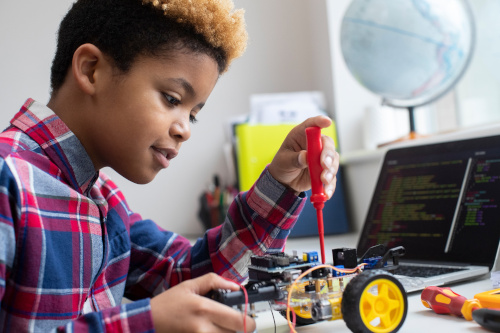
Every type of gamer has deep problem-solving. They control routes, accommodate resources, and restructure dynamic digital ecosystems. Acceleration City channels these instinctual gaming tendencies into applied robotics and computer science. Acceleration City, an open-world racer co-designed by researchers at Carnegie Mellon University and students from the Boys and Girls Clubs of Western Pennsylvania, players create their own “Cobot” (Collaborative Robot) to make ramps, activate boost pads, and traverse difficult areas. It transforms playtime into valuable engineering work.
The Core Principles of Robotics in a Gaming Context
Unlike many forms of media, video games quickly lean into the laws of physics and logic. By bridging game mechanics and robotics, educators aim to teach students complex engineering concepts in robotics without the constraints imposed by physical hardware.
From Virtual Controls to Physical Actuators
Gamers understand input and output. You push a button, and a character jumps. The same logic applies to programming physical movement in robotics. In Acceleration City, players will have to write the logic that tells their Cobot how to respond to different environmental triggers. This closed feedback loop describes how the software engineer programs actuators and moves them relative to one another on a real robot.
The Role of Programming Languages: Python and C++
Modern robotics relies heavily on structured coding. The logic learned in gamified environments translates directly to industry-standard languages:
- Python: Used for high-level logic, machine learning, and rapid prototyping in modern robotics.
- C++: Provides the low-level memory management and processing speed required for real-time robotic responses.
- Visual Block Coding: Acts as the bridge, teaching the syntax and structural logic before students transition to text-based code.
Key Robotics Concepts Explored Through Gaming
The NSF-funded Player-Programmed-Partner Games (P3G) project shows that immersive game-based environments can teach specific hard STEM skills.
Sensing and Perception
For robots to perceive their environment, they have to obtain data.
Input Devices and Data Interpretation
In games, players trigger events using sensors (virtual sight, proximity). In Acceleration City, students learn how robots read color zones and distance in a way that mimics the function of actual ultrasonic or infrared sensors on objects.
Actuation and Motion
Code must translate into movement. Gamers learn the fundamentals of kinematics and motor control by programming their Cobots to produce physical things within the game world.
Control Systems
Smooth robotics requires constant adjustment. This is all well and good, but students eventually learn that they need to optimize their code to get the Readiness of their vehicle’s speed and trajectory. This presents the basic principles of closed-loop feedback systems and PID (Proportional-Integral-Derivative) controllers utilized in industrial automation.
Gamified Education Statistics
Accessibility drives engagement. Many places that host unblocked educational content, such as those found in G+ games directories, break down institutional barriers. Students can access the best STEM education on their school’s web browser. The results speak for themselves.
| Educational Metric | Traditional STEM Programs | P3G Gamified Programs (e.g., Acceleration City) |
| Annual Learner Reach | Typically under 500,000 nationwide | Over 2.6 million learners |
| Accessibility | Limited by hardware costs | High (browser-based integration) |
| Skill Transferability | High theoretical knowledge | Highly applied logic and computational thinking |
Real-World Applications and Transferable Skills
The skills do not remain on the screen that you learn in digital environments.
Beyond the Game
Collaborative robots are used in every industry, from manufacturing to space exploration. Acceleration City prepares students for jobs where humans and machines work side by side through human-robot interaction techniques.
Developing Computational Thinking
Gamers learn to solve “impossible” puzzles in small total steps. Your training includes this kind of computational thinking, which is part and parcel of being a software engineer, data scientist, and even mechanical designer.
The Future of Coding for Gamers and Robotics
The boundary separating game play and robot programming is ever more blurred as gaming engines such as Unreal and Unity have become de facto industrial robotics simulators. The modern workforce needs the spatial awareness and digital fluency that gamers already have.
FAQs
What is the main benefit of learning robotics through gaming?
Gaming is a low-risk, high-engagement environment because students can test code, fail safely, and iterate quickly without breaking expensive physical hardware.
Which programming languages are most relevant for gaming and robotics?
The industry standards are still Python and C++. Here, you write the high-level AI and logic in Python and do your real-time hardware execution using C++.
How does Acceleration City facilitate this learning?
In Acceleration City, you are teamed with a virtual “Cobot”. Computational logic is taught by having players write code that tells the robot how to help them with racing and exploration.
Are there career opportunities at the intersection of gaming and robotics?
Yes. Robotics companies love hiring people who have worked with game engines! (Unity, Unreal) So they can create realistic physics simulations to train AI.
What are “g+ games” and how do they relate to robotics education?
G+ games are directories that host easily accessible, browser-based games. These educational titles are integrated right away into easily accessible platforms; they remove hardware barriers and bring STEM education directly to students.
